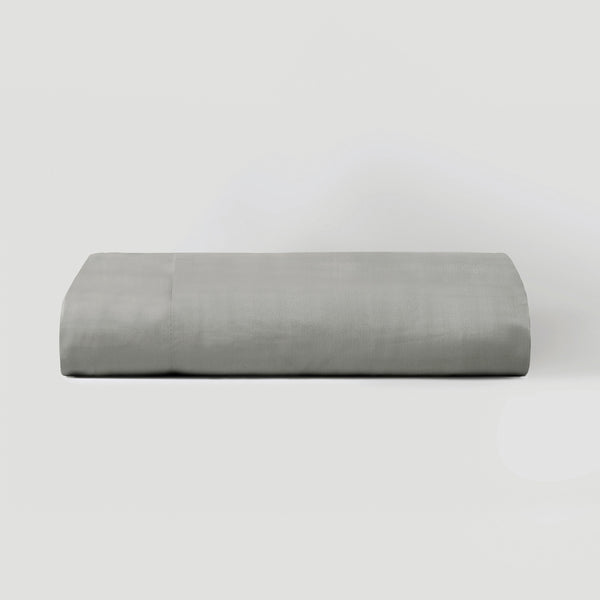
you spend a third of your life against your sheets, which is more contact time than any garment you own. the fiber decides two things at once: what sits on your skin for eight hours, and whether you wake up hot. the labelling gets in the way of both. "bamboo" on a sheet set almost always means viscose or lyocell made from bamboo pulp rather than bamboo, "microfiber" means polyester, and thread count describes a weave rather than a fiber, so a 1,000 thread count polyester sheet is still polyester. every set here is scored on its published composition. if you sleep hot, the answer is a percale weave in organic cotton or a european flax linen, both of which move moisture instead of holding it, or a lyocell if you want the silkier hand. linen, organic cotton and silk score between 92 and 96. the eucalyptus and bamboo lyocell sets score 88 and are marked as what they are: a semi-synthetic made by dissolving wood pulp, cleaner than viscose and not a natural fiber. nothing here is polyester, and nothing carries the viscose-and-spandex blend sold as bamboo jersey. sorted cheapest first, because a linen pillowcase at $27 is the least expensive way to test whether the fiber is what you have been missing.
read the bedding editA percale weave in organic cotton, or European flax linen. Percale is a plain over-under weave with air moving through it, unlike sateen, which is woven to sit smooth and traps more heat. Linen is the best of the two if you sweat, because its fibers are hollow and it keeps moving moisture even after years of washing. Lyocell is the third option and the silkiest, though it is a semi-synthetic rather than a natural fiber. Polyester and microfiber do the opposite: they hold heat against you all night.
Linen and organic cotton. Both absorb moisture and let heat escape, which is what keeps you from waking up damp, and both are single fibers with nothing spun through them. Linen breathes best and softens with every wash. Organic cotton is gentler on first use and cheaper to replace.
The fiber first, the finish second. A single natural fiber with nothing blended in gives the chemistry the fewest places to hide, and an organic cotton grown without the pesticides used on conventional cotton starts cleaner still. After that, look for GOTS, which governs the dye house and not only the field, or OEKO-TEX STANDARD 100, which tests the finished fabric for harmful substances. Wrinkle-free and easy-care finishes are the ones worth avoiding, because they are usually a resin applied to the fabric.
Almost never. Bamboo is too coarse to spin into sheeting, so the plant is dissolved into pulp and reformed as viscose or lyocell. Lyocell uses a closed-loop solvent process and is the cleaner of the two, which is why the lyocell sets here score 88 rather than failing. A set labelled bamboo viscose, or bamboo jersey with spandex in it, is a different product and is not in this edit.
Linen if you sleep hot. Its fibers are hollow and it moves moisture away faster than cotton, and it keeps doing so after years of washing. Cotton if you want softness immediately, since linen takes a season to break in. Both are natural fibers and both score in the nineties here.
Less than the fiber does. Thread count measures how many threads are woven into a square inch, which affects hand-feel and nothing else. A 1,000 thread count polyester sheet is still polyester. Read the composition first and the thread count second.
Fiber content is what touches the skin, and bedding touches it for eight hours at a stretch. Toxome reads each item's published composition and rates it, so the score reflects what the sheets are made of rather than how they are marketed.