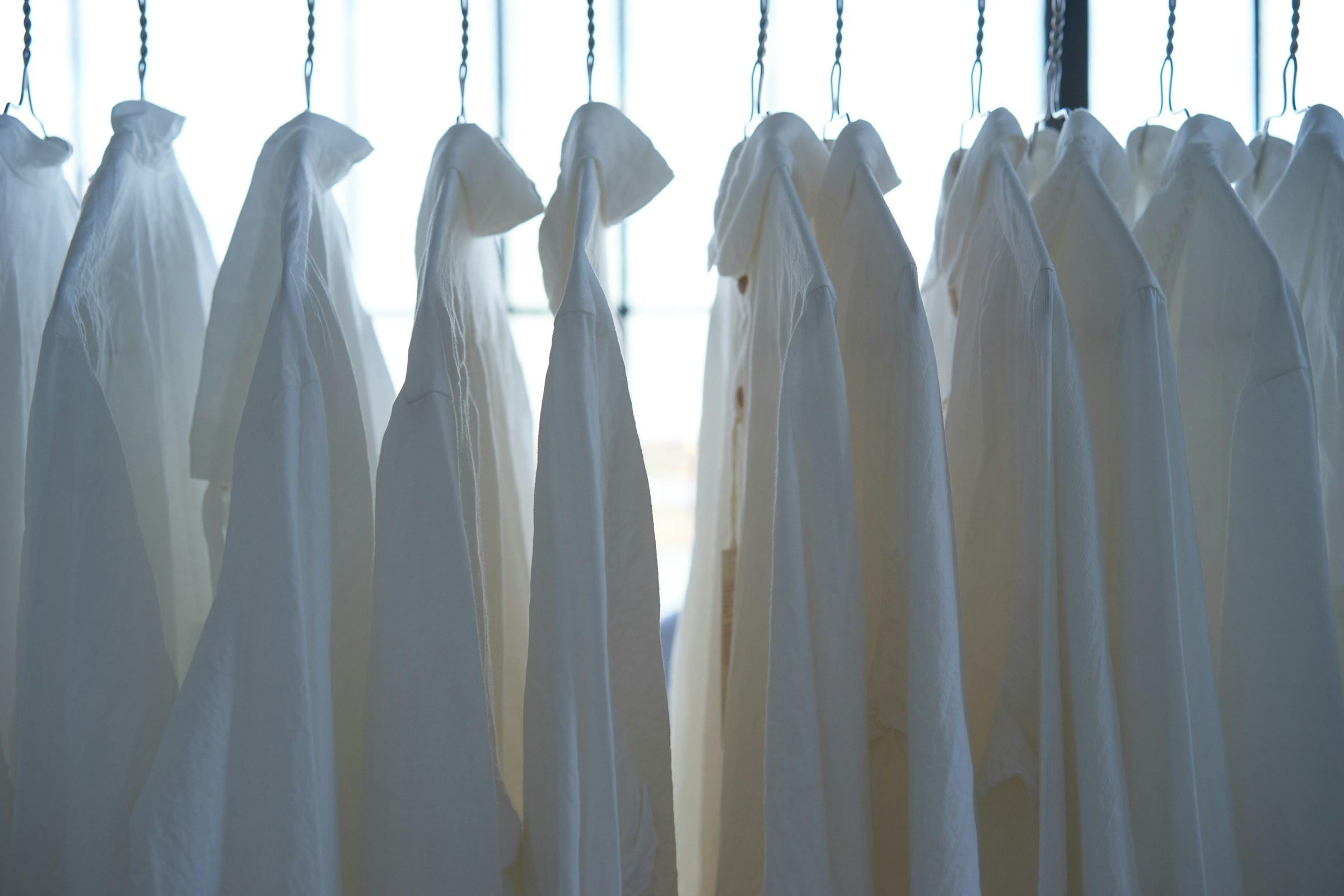
Is formaldehyde in clothing harmful? For most people, no. Its main health risk is allergic contact dermatitis, an itchy rash where fabric touches skin, and it mostly comes from wrinkle-resistant finishes on cotton, the treatment behind labels like "wrinkle free," "non-iron" and "easy care." Washing new clothes before you wear them usually lowers it. The United States has no limit on how much a garment can carry. The EU caps it at 75 mg/kg, and Japan and OEKO-TEX hold baby clothes to 16.
Formaldehyde is a gas that, in textile mills, is used to make resins that lock cotton fibers in place so the fabric stays smooth. Some of it stays behind on the finished garment. The amount is measured in milligrams per kilogram of fabric (mg/kg), which is the same as parts per million (ppm).
| Rule | Baby items | Touches skin | Doesn't touch skin |
|---|---|---|---|
| United States (federal) | No limit | No limit | No limit |
| European Union (REACH) | 75 mg/kg | 75 mg/kg | 75 mg/kg |
| Japan (Law 112) | 16 mg/kg (under 24 months) | 75 mg/kg (underwear, nightwear, socks, gloves) | No limit |
| OEKO-TEX STANDARD 100 | Under 16 mg/kg | 75 mg/kg | 150 mg/kg |
| Toxome Verified™ | 16 mg/kg | 16 mg/kg | 16 mg/kg |
Limits from EU Regulation 2018/1513, Japan's Law 112 standards and OEKO-TEX STANDARD 100, Edition 03.2024. OEKO-TEX allows 300 mg/kg for decoration materials. This is a guide, not legal advice.
Is formaldehyde in clothing harmful?
With clothing, the established health issue is skin. GAO found that "the health risk of greatest concern identified in key government reviews and in the medical literature is allergic contact dermatitis," an itchy rash where the fabric touches you.
Who reacts
Most people never react. For those who do, the rash can take a long time to trace. Dermatologists at Case Western Reserve University found that many of their patients went years before patch testing pointed to the resin, and that avoiding it is hard because textile finishes don't have to be labeled. Germany's health ministry notes that EU limits are set low enough that contact allergies generally aren't triggered at those levels.
Formaldehyde is also classified as a carcinogen, but that classification comes from breathing it in at workplace levels. It's a different exposure from wearing a finished shirt.
Where does formaldehyde in clothing come from?
It comes from resin finishes, and those finishes are almost always on cotton or cotton blends. Most clothing tests low or below what a lab can detect. Formaldehyde shows up when a garment has been treated to resist wrinkles.
What the US testing found
GAO bought 180 items from US retailers in six cities, mostly clothing plus some bedding, and had them tested. Ten went over 75 ppm, with results from 75.4 to 206.1 ppm. The highest was a 100% cotton dress shirt labeled "wrinkle free." One, a crib sheet, went over the limit for infants.
Why cotton, of all fibers
Cotton wrinkles because its fibers bend and stay bent. A formaldehyde-based resin links those fibers together so they spring back, which is what makes a shirt come out of the dryer smooth. Polyester doesn't need the help, since it holds its shape on its own.
So the finish predicts the chemical better than the fiber does. A 100% cotton shirt can carry more formaldehyde than a polyester one, and organic cotton describes how the plant was grown, not how the fabric was finished.
What is the limit for formaldehyde in clothing?
It depends on where the garment is sold and who it's for. The strictest common line is 16 mg/kg for baby clothes. The most common line for adult clothing that touches skin is 75 mg/kg.
The United States
There's no federal limit. The Government Accountability Office put it plainly in its 2010 review: "the United States has no other legal limit on the level of formaldehyde that may be found in clothing and other textiles." It also found that US clothing labels "generally do not provide information on formaldehyde content or on whether the clothing item was treated with formaldehyde."
What fills the gap is private. Retailers write their own limits into the restricted substances lists they hand to suppliers. Kohl's, for example, holds baby items to 16 mg/kg. Those lists bind factories, not the brands selling directly to consumers.
The European Union
Since November 1, 2020, clothing and textiles sold in the EU can't release more than 75 mg/kg of formaldehyde. The limit sits in entry 72 of REACH, the EU's chemical law. Jackets, coats and upholstery got a temporary 300 mg/kg allowance that ended in November 2023, so 75 now applies across the board.
Japan and OEKO-TEX
Japan has regulated formaldehyde in clothing since 1975 under Law 112. Textiles for babies under 24 months must stay at or below 16 ppm. Underwear, nightwear, socks and gloves for everyone else stop at 75.
OEKO-TEX STANDARD 100 borrows Japan's baby line. Its baby class must be "not detectable," which the standard defines as under 16 mg/kg by the Japanese method. Items worn against the skin get 75, items that don't touch skin get 150, and decoration materials get 300.
How to avoid formaldehyde in clothing
Start with proof, then the label and the laundry.
Shop Toxome Verified™
The only way to know the number is a test, so start with clothing that's already had one. Every product with the Toxome Verified™ seal was bought at retail and lab tested for formaldehyde under 16 mg/kg, and the seal links to the record.
Skip the wrinkle-free promises
The finish is the source, so the words on the tag tell you more than the fiber does. "Wrinkle free," "non-iron," "easy care" and "durable press" are the labels to look twice at. They sat on more than half of the items GAO found over the line. A shirt that needs ironing is usually a shirt without a resin finish.
Wash it first
Wash new clothes, sheets and pillowcases before they touch your skin. GAO found washing "often reduces formaldehyde levels but is not always successful," and it cited studies where levels crept back up after several washes, since the resin stays in the fabric. Germany's health ministry advises washing every new piece before you wear it.
Hold baby clothes to a stricter line
For anything a baby wears or sleeps on, look for OEKO-TEX STANDARD 100. Its baby class must test under 16 mg/kg, the same line Japan has held since 1975. Check the certificate number on the tag in OEKO-TEX's public register, since a logo alone can't be confirmed.
How to test clothing for formaldehyde?
A lab cuts a small piece of the garment, soaks it in water, and measures the formaldehyde that comes out. There's no reliable way to do it at home.
The two methods you'll see
- ISO 14184-1. The water-extraction method the EU names as its reference for the 75 mg/kg limit, according to EU guidance on entry 72. It measures free formaldehyde plus what breaks loose from the resin.
- Japanese Law 112 (JIS L 1041). The method behind Japan's limits and OEKO-TEX's baby class. GAO used it for its US testing.
What a result looks like
The lab reports a number in mg/kg, or "not detected" below its reporting limit. A single number only describes the fabric that was tested. A different color, factory or season can come back different, which is why the date and the product on a report matter as much as the result.
What brands should know before a buyer asks
Formaldehyde doesn't draw the class actions PFAS does, but it has cost real money. In 2023, a California jury awarded more than $1 million to four American Airlines flight attendants who said their uniforms made them sick. Their lawsuit claimed the uniforms contained traces of formaldehyde, toluene and other chemicals, and the jury found the uniforms were a "substantial factor in causing harm."
The questions that come first
- Does any style carry a wrinkle-free, non-iron or easy-care finish? That's where to test first.
- Is there a lab result on the finished garment, or only a mill certificate for the fabric? A finish can be added after the fabric is certified.
- Which line are you held to? A brand selling into Europe needs 75 mg/kg. A brand making baby clothes should be thinking in 16.
For consumers, the short version holds: wash new clothes before wearing them, and look twice at anything that promises never to wrinkle. For more ways to read a garment, see how to check if your clothes contain harmful chemicals and how US clothing compares with Europe's chemical limits.
Clothing tested for formaldehyde: Toxome Verified™
Toxome Verified™ tests every product for formaldehyde, PFAS and fiber content, and holds every category to 16 mg/kg, the line Japan and OEKO-TEX keep for babies. The sample is bought at retail, the same piece consumers take home.
Frequently asked
For most people, no. The main health risk of formaldehyde in clothing is allergic contact dermatitis, an itchy rash where fabric touches skin. It mostly affects people already sensitized. Washing new clothes before wearing them usually lowers levels.
Wash new clothes before wearing them, and skip labels that say wrinkle free, non-iron, easy care or durable press. For proof, look for the Toxome Verified™ seal: lab tested under 16 mg/kg, bought at retail.
The US has no federal limit for formaldehyde in clothing. The EU caps it at 75 mg/kg in clothing that touches skin. Japan and OEKO-TEX hold baby clothes to 16 mg/kg and skin-contact clothing to 75.
In clothing, 75 mg/kg is the most common acceptable level for adult items that touch skin. It's the EU's legal limit and Japan's limit for underwear and nightwear. Baby clothes are held to 16 mg/kg in Japan and under OEKO-TEX.
No. Most clothes test low or not at all. In a US government test of 180 items, 10 went over 75 ppm, and the highest was a 100% cotton dress shirt labeled wrinkle free. Wrinkle-resistant finishes are the usual source.
A lab soaks a piece of the fabric in water and measures what comes out, using ISO 14184-1 or Japan's Law 112 method. There's no reliable home test. Products with the Toxome Verified™ seal were lab tested under 16 mg/kg.
Comments
No comments yet.
That didn't go through. Try again.